
Are you living with the persistent ache of lower back pain, especially if it’s caused by a disc herniation? You’re not alone. Millions of Canadians experience this debilitating condition, which can severely limit daily activities and quality of life. While many traditional treatments focus on managing symptoms, a revolutionary approach known as Fascial Manipulation is gaining significant recognition for its remarkable effectiveness in addressing the root cause of discomfort.
At Body & Mind Osteopathic Clinic in Toronto, we specialize in advanced manual therapy techniques designed to help you regain your mobility, reduce pain, and restore your well-being. This detailed guide will explore Fascial Manipulation – a highly effective solution for conditions like herniated discs and chronic lower back pain.
What is Fascial Manipulation?
Fascial Manipulation is an advanced manual therapy technique that targets the fascia—a connective tissue network that surrounds and supports muscles, bones, nerves, and organs. Developed in Italy by Luigi Stecco, an Italian physiotherapist, this approach focuses on specific points in the fascial system that, when treated, can restore mobility, reduce pain, and improve function.
Unlike traditional massage or stretching techniques, Fascial Manipulation goes deeper. It looks at the body as a whole, identifying the root cause of pain rather than just treating symptoms.
How Fascial Manipulation Works?
Understanding Fascia
To understand how Fascial Manipulation works, you need to first learn about fascia. Picture your body as a detailed and connected three-dimensional web. This web known as fascia, is a thin but strong tissue that stretches through almost every part of your body. It wraps around muscles, bones, nerves, organs, blood vessels, and even individual cells. Fascia supports and shields these structures while also working as a communication network. It helps parts of your body move against one another.
In its natural state, fascia stays soft and flexible, which makes movement smooth and easy. But things like injuries bad posture, inflammation repetitive movements surgical scars, or even stress can make the fascia stiff or tense. When this happens, it restricts movement and creates pain.
Fascial Manipulation works by:
- Applying deep, focused manual pressure to specific fascial points (called “Centers of Coordination”)
- Releasing adhesions and tension
- Restoring smooth gliding between muscle groups
- Reactivating proper movement patterns
Fascial Manipulation method is evidence-based and offers targeted relief for patients who haven’t responded to conventional physiotherapy or chiropractic care.
Conditions Treated by Fascial Manipulation
Fascial Manipulation works well as herniated disc manual therapy technique and lower back pain treatment, but it also helps with many other issues beyond the lumbar spine. It offers relief for a variety of conditions such as:
- Chronic Pain Treatment: Persistent aches and pains in various parts of the body.
- Neck Pain: Stiffness, limited rotation, and referred pain.
- Shoulder Pain: Rotator cuff issues, frozen shoulder, and impingement.
- Headaches and Migraines: Often linked to fascial tension in the neck, head, and face.
- Sciatica: Nerve pain radiating down the leg.
- Joint Stiffness and Limited Mobility: Improving the range of motion in hips, knees, ankles, and wrists.
- Sports Injuries: Enhancing recovery and performance by optimizing tissue mobility.
- Postural Dysfunctions: Addressing imbalances that contribute to poor posture.
- Degenerative Disc Disease of the Lumbosacral Spine: While disc degeneration is a natural process, Fascial Manipulation can help manage associated pain and improve function by addressing surrounding soft tissue restrictions. As Physio-Pedia highlights, optimizing movement is crucial for managing this condition.
- Post-Surgical Scars: Releasing adhesions and restrictions around surgical sites.
- Tendonitis and Bursitis: Reducing tension on swollen tendons and irritated bursae.
This connective tissue therapy can be a game-changer for anyone seeking mobility improvement therapy and relief from lasting musculoskeletal pain.
How Does Fascial Manipulation Help with Herniated Discs?
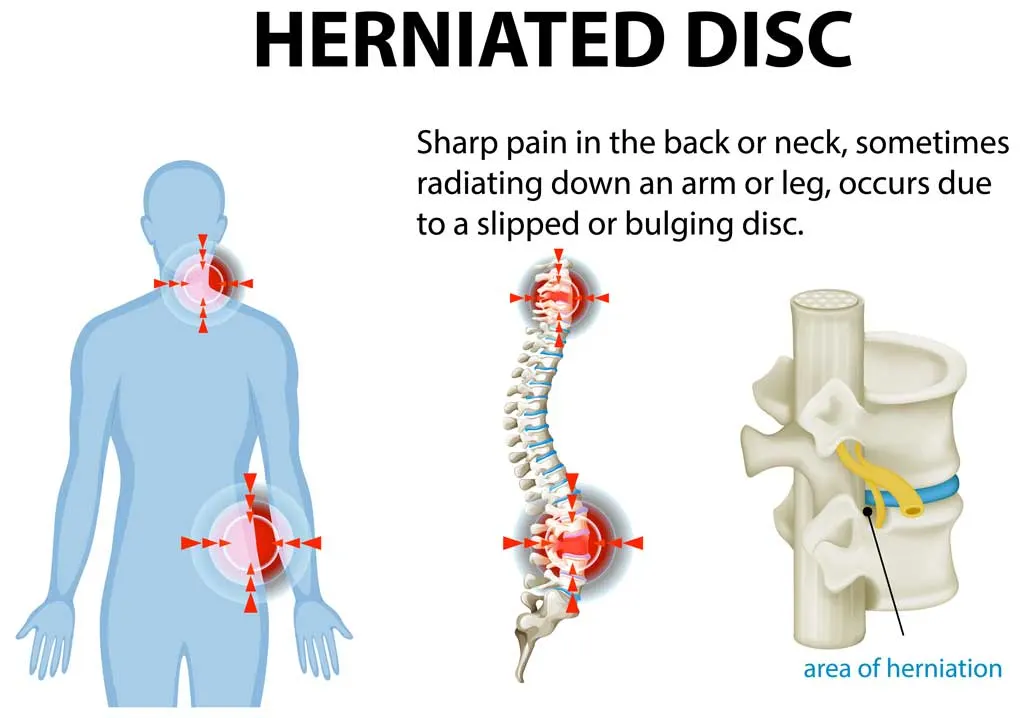
A herniated disc also called a “slipped” or “bulging” disc, happens when the soft center of an intervertebral disc forces through its stronger outer part. This pressure can affect nearby nerves causing lower back pain sciatica that shoots down the leg, numbness, or even muscle weakness.
Traditional methods aim to ease inflammation and lessen pain near the disc. Although those methods can work, Fascial Manipulation takes another approach. It looks at the fascial network around the affected area. Here’s how it works:
Releasing Tension:
When a disc herniates nearby muscles and fascia tend to tighten up to protect the area. This tightness can press harder on the disc and nerves making the pain worse. Fascial Manipulation works to ease these myofascial constraints and relieve pressure on the injured spot.
Restoring Biomechanics:
A herniated disc can mess up how the entire body moves and functions. Fascial Manipulation works by addressing related fascial spots even those far from the injury. This method restores proper movement and reduces strain on the damaged disc.
Reducing Nerve Compression:
Tight fascia can pinch or press on nerves sometimes or . Fascial Manipulation releases these tight areas to relieve pressure, which can ease nerve-related issues like sciatica.
Promoting Healing:
Releasing tight fascia improves both blood circulation and lymph flow. With better circulation, the body can heal itself more around the injured disc.
A recent study published in PubMed (PMID: 39859973) specifically evaluated the effectiveness of Fascial Manipulation in patients with lumbar disc herniations. The results were compelling: the study group receiving Fascial Manipulation showed significantly greater improvements in pain reduction, increased mobility, and improved results in stretch tests (like the straight leg raise test) compared to a control group receiving traditional physiotherapy treatments. This provides strong evidence for Fascial Manipulation being a more effective way to treat lower back pain from herniated discs.
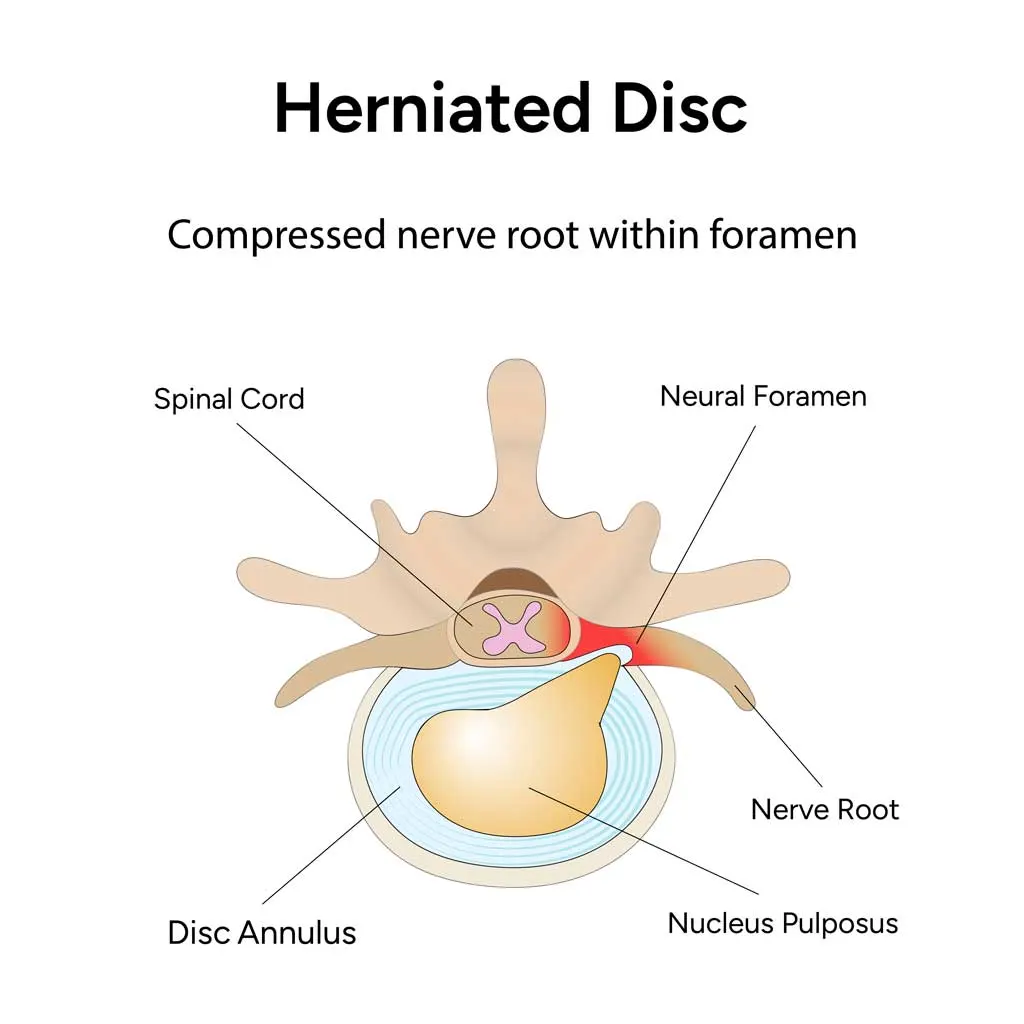
Herniated Disc Illustration
This illustration shows what happens when someone has a herniated disc in their spine.
Inside each disc is a soft center called the nucleus pulposus. When the outer layer (disc annulus) becomes weak or damaged, this soft part can bulge out. It’s pressing on a nerve root inside the neural foramen (a small space where nerves exit the spine). This pressure can cause pain, numbness, or tingling that travels down the back or legs, depending on which nerve is affected.
What to Expect During a Fascial Manipulation Session
When you visit Body & Mind Osteopathic Clinic in Toronto for Fascial Manipulation, your assessment will be detailed and patient-focused:
1. Detailed Assessment
You will start the session with an in-depth intake process. Your practitioner will talk about your medical history current symptoms, lifestyle habits, and problem areas. This helps them get the full picture of your condition.
2. Movement Analysis
The osteopathic practitioner will ask you to do different movements. This step allows them to check your range of motion and find areas where movement feels limited.
3. Palpation and Identification of Densifications
The main part of Fascial Manipulation involves the practitioner using their hands to feel specific areas called “centers of coordination.” These are places where fascial tension often builds up. They are trained to notice small changes in how the tissue feels, spotting dense or tight areas that show restrictions.
4. Targeted Manual Treatment
After locating a tight spot, the practitioner presses and on that area. They use deep steady pressure or friction on the problem spot. This can feel strong and sometimes a little painful as the fascia loosens up. People often describe the feeling like a deep ache or burning that disappears.
5. Post-Treatment Assessment
After the procedure, the osteopathic practitioner will check how you move and feel to see the direct effects of the treatment.
How Long is Fascial Manipulation session?
A typical Fascial Manipulation session might last between 45-60 minutes. The number of sessions required depends on how serious and long-lasting your condition is, but noticeable changes often happen within a few visits. One study showed impressive results even after just two treatments for people with disc herniations.
Why Choose Body & Mind Osteopathic Clinic for Fascial Manipulation in Toronto?
At Body & Mind Osteopathic Clinic in Toronto, our practitioners are highly trained in the precise art and science of Fascial Manipulation. We combine our expertise in this advanced technique with a comprehensive understanding of osteopathic principles, ensuring a holistic and individualized treatment plan for every patient.
Start Your Journey to a Pain-Free Life
If you’re experiencing chronic lower back pain, especially from a herniated disc, and are looking for an effective non-surgical treatment, Fascial Manipulation could be the solution you’ve been searching for. Don’t let pain dictate your life any longer.
Ready to learn how fascial manipulation helps herniated disc pain and what is fascial manipulation therapy and how does it work for your specific condition? Our team is here to help.
Fascial Manipulation Near Me
Call us today at (647) 995-7722 or book your initial consultation online to discover how Fascial Manipulation can help you regain your mobility, reduce your pain, and get back to living life to the fullest.
Reference
(*) National Library Of Medicine. Assessment of the Effectiveness of Fascial Manipulation in Patients with Degenerative Disc Disease of the Lumbosacral Spine: https://pubmed.ncbi.nlm.nih.gov/39859973/

Written By: Vadzim Siniauski
Vadzim Siniauski is Certified Osteopathic manual practitioner DOMP, MCIO, and Registered Massage Therapist (RMT), MD (Belarus). Vadzim has an extensive experience in musculoskeletal health, pain management, and manual therapy techniques.
Our Editorial Process
At Body & Mind Osteopathic Clinic, we publish practical, experience-based content to help educate readers on osteopathy, rehabilitation, and wellness.
Writing: All our content is developed by experienced osteopathic practitioners and RMTs. It draws on reputable scientific literature, clinical research, and our real-world experience working with conditions such as back pain, joint stiffness, postural imbalances, and injury recovery.
Editing: Each article is reviewed internally by a senior practitioner to ensure accuracy, clarity, and alignment with our treatment protocols and patient education standards.
Verified by Practitioners: Before publication, content is verified by a licensed member of our clinical team to confirm that the medical information provided aligns with current best practices in manual therapy and osteopathic care.
Frequently Asked Questions
What is Fascial Manipulation Therapy?
Fascial Manipulation is a specialized manual therapy that focuses on the fascia—connective tissue that surrounds muscles. It aims to restore movement and relieve chronic pain, especially when other treatments haven’t worked.
What conditions can Fascial Manipulation treat?
Not only does this therapy help with herniated discs and back pain, but it also effectively targets neck stiffness, shoulder tension, hip and knee pain, and ankle or foot dysfunction.
Is Fascial Manipulation method available in Toronto?
Yes, Fascial Manipulation therapists in Toronto offer targeted treatment for chronic pain and musculoskeletal conditions using evidence-based techniques.
How does Fascial Manipulation differ from massage therapy?
While massage therapy provides general relief, Fascial Manipulation specifically addresses restrictions in the fascia. As a result, it offers deeper and longer-lasting benefits.
Can Fascial Manipulation help with herniated discs?
While massage therapy provides general relief, Fascial Manipulation specifically addresses restrictions in the fascia. As a result, it offers deeper and longer-lasting benefits.
How many sessions are needed for results?
Most clients notice improvement after 1–3 sessions, but chronic conditions may require 4–6 treatments depending on severity and response to therapy.
Is Fascial Manipulation therapy safe?
Yes, it is a safe and non-invasive method. When administered by a trained therapist, it offers effective relief with minimal risk and no recovery downtime.