
Muscle Energy Technique (MET) is an advanced form of manual therapy used by osteopaths and massage therapists to treat pain, improve mobility, and restore proper joint function. As a patient-assisted stretching technique, MET involves gentle isometric muscle contractions followed by passive stretching. This helps your tissues relax and your joints realign.

At Body & Mind Osteopathic Clinic in Toronto and Vaughan, MET is one of our most effective techniques for reducing muscle tension, increasing flexibility, and accelerating recovery from musculoskeletal dysfunction. Whether you suffer from back pain, neck stiffness, or limited mobility, MET can become a core therapy in your personalized rehabilitation plan.
What is Muscle Energy Technique (MET)?
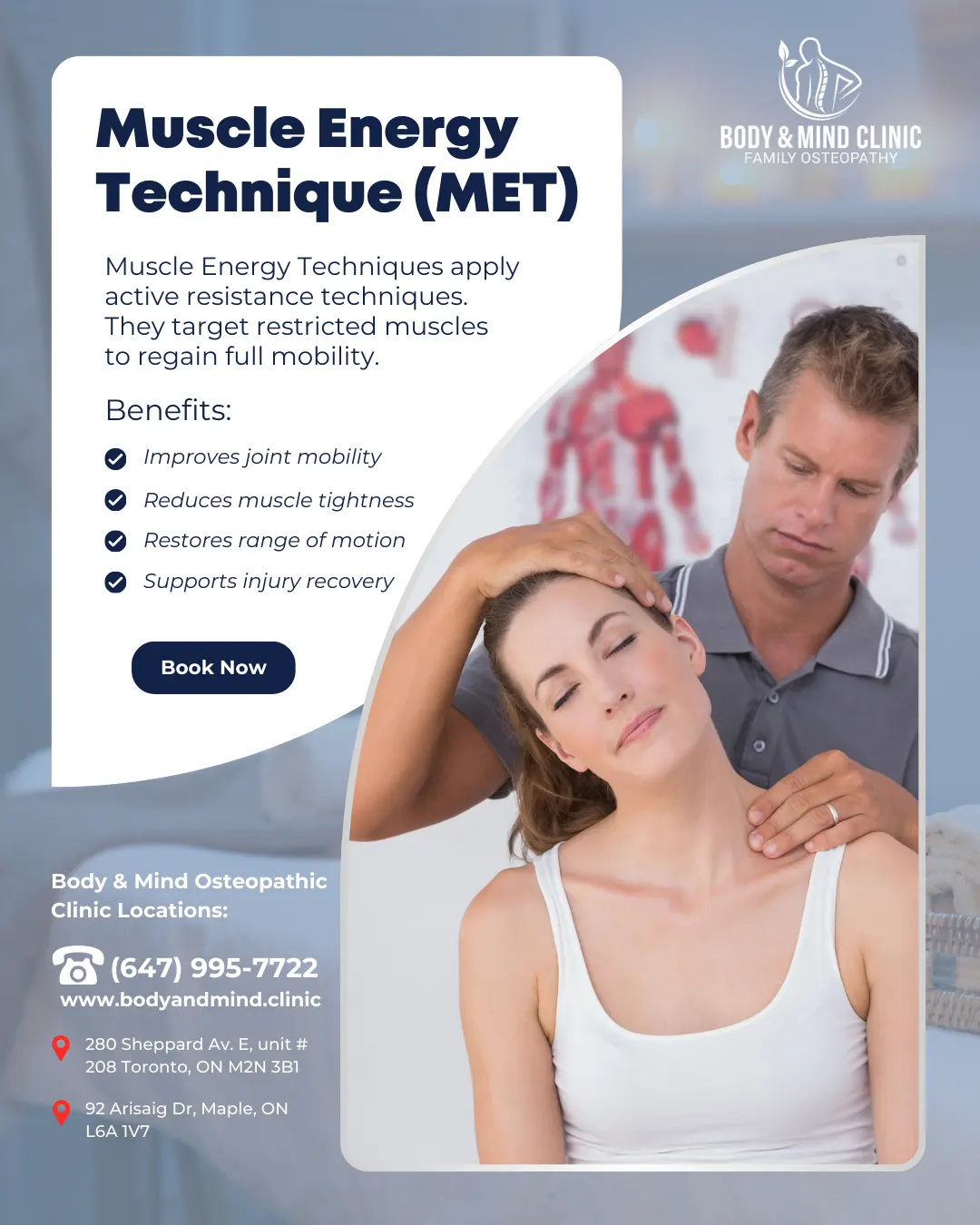
Muscle Energy Technique is a non-invasive manual therapy developed in osteopathy that requires active participation from the patient. The practitioner guides the patient to contract specific muscles against gentle resistance and then uses the natural relaxation phase to stretch or mobilize the joint.
Core Principles:
- Isometric Contraction: Muscle contracts without changing its length.
- Post-Isometric Relaxation: Patient muscle is more pliable after contraction, allowing deeper stretch.
- Reciprocal Inhibition: Engaging opposing muscles to encourage the target muscle to relax.
MET can be very effective because it allows therapists to correct joint misalignments and soft tissue restrictions without forceful manipulations. Thus, it is safe and helpful for people of all ages.
Advantages of Muscle Energy Technique
Muscle Energy Technique Benefits Include:
- Relieving chronic back and neck pain
- Improving joint range of motion
- Reducing muscle stiffness and tightness
- Promoting postural alignment
- Supporting injury recovery and rehabilitation
- Enhancing circulation and lymphatic flow
- Aiding with spinal alignment
Research has demonstrated that MET is effective in reducing both pain intensity and function improvement in patients with mechanical neck pain and chronic low back pain. MET is frequently able to produce better results in flexibility and tension release than static stretching.
Who Can Benefit from Muscle Energy Technique?
Our osteopathic manual practitioners and massage therapists often use Muscle Energy Technique to help:
- Office workers with posture-related tension
- Athletes managing performance-related muscle strain
- Seniors experiencing mobility loss or stiffness
- Post-surgical patients regaining joint function
- Pregnant women dealing with lower back discomfort
- Anyone with TMJ dysfunction, hip tightness, or spinal misalignment
How to Prepare for Your MET Session
Before your first MET treatment:
- Wear comfortable clothing for movement and stretching
- Stay hydrated to support tissue elasticity
- Avoid strenuous activity right before your appointment
- Arrive early to discuss your symptoms and medical history
Your therapist will perform a thorough assessment to determine which joints or muscles are involved and tailor your session accordingly.
What to Expect During & After an MET Treatment?
During your session, your therapist will:
- Identify the restricted muscle or joint.
- Position you for optimal resistance.
- Instruct you to contract your muscle gently for 5–10 seconds.
- Guide the muscle into a deeper stretch during relaxation.
This process may be repeated several times for each area. Muscle Energy Technique is gentle and should not be painful. You may feel a light release or immediate improvement in mobility.
Post-treatment:
You may experience mild soreness (similar to a workout), which resolves quickly. Drink water, stretch gently, and follow any at-home recommendations.
Expert Insights & Evidence-Based Support
The table below outlines the demonstrated benefits of Muscle Energy Technique (MET) based on expert opinions and research findings, particularly in the context of back pain, neck pain, shoulder function, and when compared to PNF and static stretching.
| Condition/Comparison | Expert Insight & Evidence-Based Support |
|---|---|
| Back Pain | Muscle Energy Technique significantly improves pain and disability in patients with chronic low back pain. |
| Neck Pain | MET outperforms static stretching in improving function and reducing discomfort in individuals with neck pain. |
| Shoulder Function | This therapy can enhance the mobility of the Acromioclavicular (AC) joint and reduce tension in the muscles of the shoulder girdle. |
| PNF vs. MET | Muscle Energy Technique utilizes lighter resistance and is often better tolerated by patients who are sensitive or elderly compared to Proprioceptive Neuromuscular Facilitation (PNF). |
| Static Stretching vs. MET | Additionally, MET provides more lasting changes in flexibility and joint alignment compared to static stretching. |
Find the Best Muscle Energy Technique near me in Toronto
Call Body & Mind Osteopathic Clinic on (647) 995-7722
If you’re struggling with tight muscles, reduced flexibility, or joint dysfunction, Muscle Energy Technique could be the solution you’ve been looking for.
At Body & Mind Osteopathic Clinic, our trained osteopaths and RMTs use MET to help patients recover faster, move better, and live pain-free.
Book Online to schedule your personalized assessment today.
Serving patients in Toronto, North York, Vaughan, Maple, Richmond Hill, and surrounding areas.
Frequently Asked Questions
What is Spencer Muscle Energy Technique?
The Spencer Technique is a type of Muscle Energy Technique used specifically for improving shoulder mobility and reducing joint stiffness. It involves a series of gentle, active movements performed with the patient’s help to treat frozen shoulder, rotator cuff injuries, and restricted range of motion in the shoulder joint.
What is the difference between PNF and MET?
While both Proprioceptive Neuromuscular Facilitation (PNF) and MET involve muscle contractions and stretching, the main differences are:
- PNF uses stronger, often maximal contractions and is common in sports rehab.
- MET uses gentle, controlled contractions, focusing on joint alignment and neuromuscular re-education, making it ideal for osteopathic and manual therapy.
Who developed Muscle Energy Technique?
Muscle Energy Technique was developed by Dr. Fred Mitchell, Sr., D.O. in the 1940s. It has since become a foundational method in osteopathic manual therapy, widely used to address muscle imbalances, joint restrictions, and postural dysfunctions.
What is the Muscle Energy Technique for low back pain?
For low back pain, MET targets shortened or tight muscles that affect the lumbar spine. Techniques include:
- Isometric contractions of the hamstrings, hip flexors, and lumbar muscles.
- Post-isometric relaxation to increase flexibility.
- Pelvic alignment correction to address imbalances. This helps relieve tension, improve range of motion, and reduce strain on the lumbar spine for lasting relief.